Everest Three pass Trek 20 Days

Tour Info

Trip code

KFT-83474

Starting Point/ End Point

Kathmandu

Accommodations

Lodge/ Tea House

Max Altitude

5,545m

Duration

20 days

country

Trip grade

Challenging

Best Season

march- may Sep-nov

Highlights

  • Scenic mountain flight to Lukla with stunning Himalayan views
  • Visit and explore the cultural and tourist center of the Everest region, Namche bazar
  • Get to Sagarmatha National Park, a UNESCO World Heritage Site
  • Take in sight of the magnificent Everest, Lhotse, Makalu, Cho Oyu, Ama Dablam and more peaks in the Himalayas
  • Witness the amazing Khumbu Icefall and get to Everest Base Camp (5,364m).
  • Hike up to Kala Patthar (5,545m) to catch sight of the best sunrise view of Everest mountain
  • Crossing the difficult Cho La Pass (5420m) and have a high altitude adventure
  • Visit the serene Gokyo Valley, the turquoise Gokyo Lakes and the panoramic view of Gokyo Ri (5360m)
  • Explore typical Sherpa villages, monasteries, prayer wheels, mani walls, and prayer flags
  • Experience the combination of Everest Base Camp together with full days of Gokyo Lakes and Cho La Pass and lots of Sherpa culture

Overview

Everest Base Camp Trek via Gokyo Lake is one of the most complete and dramatic trekking route in Nepal. It is the combination of Everest Base Camp (5364m), Gokyo Ri (5357m) and Cho La pass (5420m) which adds some variety to the trekking experience as compared to the standard Everest Base Camp trek route. This trek passes through famous landmarks of the Himalayas, serene valleys, turquoise glacial lakes and high passes located in the Khumbu region, within Sagarmatha National Park. The journey begins with a scenic adventure to Lukla at 2,860 meters, then continues through Sherpa villages, woods, rivers and suspension bridges. At Namche Bazaar, Dingboche and Gokyo are carefully planned acclimatization stops that help ensure safe altitude-gaining. Overall, the trek balances culture, nature and high altitude adventure and offers safe and comfortable hours daily as trekking.

Itinerary

Day 1: Arrival in Kathmandu (1,400m)

As soon as you arrive in Nepal, our representative will be waiting for you at Tribhuvan International Airport, where they will greet you warmly and assist you during the transfer to the hotel in Kathmandu. Your first view of Kathmandu's busy capital city, with hills far away and its vibrant streets, will come here. You may rest after the journey or take a stroll around Thamel. It is filled with cafes, shops and trekking equipment stores. Enjoy a welcome meal and a briefing on the trek in the evening. You will also meet your guide to go over the final preparations.

  • Max Elevation: 1,400 meters (4,593 feet)
  • Travel Distance: Approximately 6 kilometers
  • Travel Hours: 20 to 30 minutes drive
  • Accommodation: 3-star standard hotel
  • Meal: Welcome Dinner
Day 2: Trek Briefing + Kathmandu Sightseeing

Your guide will give you a thorough trek briefing today. After exploring the most important cultural and spiritual sites in Kathmandu Valley, you will gain a deeper understanding of Nepal's religion, history and architecture.

Swayambhunath Stupa: The Swayambhunath Stupa is situated atop a hill overlooking the valley of Kathmandu and is believed to be the oldest religious place in Nepal. The presence of prayer wheels and monkeys around the stupa makes it lively yet peaceful.

Pashupatinath Temple: Pashupatinath Temple is considered the most important Hindu temple in Nepal. It is situated at the bank of the Bagmati River. Pashupatinath is a very powerful place where rituals, ceremonies and cremations take place on a regular basis.

Boudhanath Stupa: It is a massive white stupa and is regarded as an important place for Tibetan Buddhism. Boudhanath is one of the largest stupas in the world, giving a feeling of peace with the help of prayer wheels and the chanting of monks.

Patan Durbar Square: The Patan Durbar Square is one of the greatest architectural pieces built in the form of the Newari style. It is a reflection of centuries of artistic excellence, cultural riches and preservation in the Kathmandu Valley.

  • Max Elevation: 1,400 meters (4,593 feet)
  • Travel Distance: Approx. 25 km (city sightseeing)
  • Travel Hours: 5 to 6 hours sightseeing
  • Accommodation: 3-star standard hotel
  • Meal: Breakfast
Day 3: Flight to Lukla (2,860m) + Trek to Phakding (2,610m)/ Drive to Ramechhap (1,218 m) + Flight to Lukla + Trek to Phakding

You will fly from Kathmandu, Nepal, to Lukla in the early morning. This is one of the most exciting airports on the planet. You will meet your trekking team and start your journey in the Lukla area after landing. The trail gently descends through Sherpa village, prayer flags and suspension bridges along the Dudh Koshi River, before arriving at Phakding. This peaceful riverside settlement is the perfect place to spend your first night.

Alternatively, during the high peak trekking seasons, flights to Lukla are often operated from Ramechhap instead of Kathmandu due to air traffic management and airport congestion. In this case, you will first drive from Kathmandu to Ramechhap, which usually takes around 4 to 5 hours, depending on road and traffic conditions. From Ramechhap Airport, you will then take a short scenic flight to Lukla, which takes approximately 20 minutes (0.3 hours).

This alternative route helps maintain smoother flight operations during busy trekking periods and allows travelers to continue their journey toward the Everest region with minimal delays. Overall, the journey includes 4 to 5 hours of drive and approximately 20 minutes of flight time.

  • Max Elevation: 2,860 meters (9,383 feet)
  • Travel Distance: 8 kilometers trekking
  • Travel Hours: 30–40 minutes flight + 3–4 hours trek/ 4-5 hours drive, 20 minutes flight + 3-4 hours trek
  • Accommodation: Mountain lodge/teahouse
  • Meal: Breakfast, Lunch, Dinner
Day 4: Trek to Namche Bazaar (3,440m)

The trek today follows the Dudh Koshi River Valley through pine forests, small villages and iconic suspension bridges such as the Hillary Bridge. The trail steepens after entering Sagarmatha National Park. It is a long climb uphill. You may see Mount Everest for the first time as you climb depending on the weather and clarity of view.  Additionally, you may also come across Danphe (Lophophorus impejanus) if your luck shines on this day as you head towards Namche Bazaar. Namche Bazaar is the bustling Sherpa trading center of the Everest area.

  • Max Elevation: 3,440 meters (11,286 feet)
  • Travel Distance: 10–11 kilometers trekking
  • Travel Hours: 6–7 hours walk
  • Accommodation: Mountain lodge/teahouse
  • Meal: Breakfast, Lunch, Dinner
Day 5: Acclimatization Day at Namche Bazaar (3,440m)

The purpose of the day will be acclimatization, which means that you will be getting adjusted to the increased elevation while continuing to stay active. Unlike resting, on this day, you will walk for a while on a pleasant trail from Namche Bazaar to the Everest View Hotel, the favorite viewpoint in the Khumbu region. Also acting as a built in a natural amphitheater, Namche Bazaar offers views of Kongde Ri and, on clear days, Mount Everest.
It provides magnificent views of the Everest Range, including Everest, Ama Dablam, Mt. Thamserku, Tabuche Peak, and Lhotse. Returning to Namche Bazaar, you will have free time during which you can explore the town a little. Namche is the main town in the Everest region and lies at an elevation of 3,440 meters above sea level.
In addition, it is the largest trade center for the local Sherpas and trekkers traveling toward the glaciers. Namche is famous for its many bakeries, cafes, trekking shops, local markets, monasteries, and even museums dedicated to Sherpa culture and history. It will be helpful to spend your time walking around the town and continuing the acclimatization process. If you plan your visit right, you can also witness the lively Saturday Market in this small mountain town, which takes place each weekend.

  • Max Elevation: 3,880 meters (12,729 feet)
  • Travel Distance: 5–6 kilometers hiking
  • Travel Hours: 3–4 hours walk
  • Accommodation: Mountain lodge/teahouse
  • Meal: Breakfast, Lunch, Dinner
Day 6: Trek to Tengboche (3,867m)

you get to have beautiful views of the entire Himalayan range. You will see Mount Everest alongside the other two mountains, Ama Dablam and Thamserku, dominating the entire skyline. In addition, while moving on the trail, you will be able to catch a glimpse of the Tengboche Monastery, which is an active spiritual site commonly called the capital of monks. You will also encounter various kinds of flora and fauna, including musk deer and mountain goats, among others, together with beautiful prayer flags.
You descend slowly towards the Dudh Koshi River. After crossing a suspension span, the trail climbs steadily uphill through rhododendron, pine, and other beautiful forests. Spring is a particularly lovely time to hike on this trail. Following the trail, you reach Tengboche, home to the renowned monastery hidden among the mountains. In the afternoon, after 3 PM, you attend a special Puja ceremony inside the monastery, taking part in the evening prayers and experiencing the deeply spiritual atmosphere of Tengboche, adding a meaningful cultural highlight to your stay. From the guest house, you can even enjoy some of Everest’s most stunning views alongside the spectacular peaks of Ama Dablam and Lhotse.

  • Max Elevation: 3,867 meters (12,687 feet)
  • Travel Distance: 9–10 kilometers trekking
  • Travel Hours: 5–6 hours walk
  • Accommodation: Mountain lodge/teahouse
  • Meal: Breakfast, Lunch, Dinner
Day 7: Trek to Dingboche (4,410m)

Today's hike takes you into the high alpine zone. As vegetation gradually disappears, the landscape becomes more rugged and dramatic. We continue our journey by crossing a suspension bridge, during which we can witness the grand views of Ama Dablam. We then reach Pangboche, the oldest Sherpa settlement in the region, before the trail continues through wide glacial valleys. Along the way, you can see yaks grazing on high mountain pastures while enjoying some of the closest and most immersive views of Ama Dablam. The trail also offers spectacular views of Lhotse, while the changing route reveals Ama Dablam from different angles, showcasing its striking beauty throughout the journey. Dingboche, with its stone-walled fields and panoramic mountain scenery, provides a peaceful and rewarding setting at high altitude.

  • Max Elevation: 4,410 meters (14,468 feet)
  • Travel Distance: 10–12 kilometers trekking
  • Travel Hours: 5–6 hours walk
  • Accommodation: Mountain lodge/teahouse
  • Meal: Breakfast, Lunch, Dinner
Day 8: Trek to Chhukung(4,730m)

On this day, the trail is shorter but climbs steadily into the upper Imja Valley. As you ascend, the scenery becomes wilder and more dramatic, with vast glacial landscapes surrounded by towering peaks. Although you do not see Mount Everest and Nuptse clearly from this section, you can enjoy impressive sights of the surrounding peaks such as Ama Dablam and Island Peak. The route gradually feels more remote and alpine, with fewer settlements and a stronger sense of wilderness as you approach Chukhung. This quiet village sits in a stunning high-altitude setting and serves as an ideal base for acclimatization and further exploration into the surrounding mountains.

  • Max Elevation: 4,730 meters (15,518 feet)
  • Travel Distance: 5–6 kilometers trekking
  • Travel Hours: 2–3 hours walk
  • Accommodation: Mountain lodge/teahouse
  • Meal: Breakfast, Lunch, Dinner
Day 9: Acclimatiztion Hike to Chhukung Ri (5,550m)

Today is set aside for acclimatization as you hike up to Chhukung Ri. This steep and challenging climb rewards you with one of the most impressive viewpoints in the upper Everest region. From the top, you can enjoy sweeping views of Ama Dablam, Island Peak, Makalu, the Imja Valley, and surrounding glacial landscapes. After spending some time at the summit and taking in the scenery, you descend back for rest and prepare for the higher elevations and more demanding trails ahead. 

  • Max Elevation: 5,550 meters (18,209 feet)
  • Travel Distance: 6–7 kilometers trekking
  • Travel Hours: 3–4 hours walk
  • Accommodation: Mountain lodge/teahouse
  • Meal: Breakfast, Lunch, Dinner
Day 10: Trek to Lobuche (4,910m) via Kongma La Pass (5,545m)

As you cross Kongma La Pass, which is the highest pass of the trek, you begin one of your most challenging and exciting trekking days. The morning starts off with a steep climb over rocky which takes around 3 to 4 hours from Chhukung to reach the top, which includes traversing through frozen terrain, requiring careful footing and good endurance. As you continue your journey, the surrounding landscape opens up to breathtaking views of Himalayan wilderness and icy peaks from the top of the pass. From the top of the pass, you can see the front faces of Chola Tse and Taboche, along with one of the best views of Nuptse during the trek. On the descent towards Lobuche, you cross sections of the Khumbu Glacier and continue through rugged moraine terrain. Before the final stretch to Lobuche, we take a packed lunch en-route. As you continue towards Lobuche, Ama Dablam remains visible for much of the journey. The following journey and gradual traverse towards Lobuche is long and rough before reaching the small mountain settlement. 

  • Max Elevation: 5,545 meters (18,192 feet)
  • Travel Distance: 12–13 kilometers trekking
  • Travel Hours: 8–9 hours walk
  • Accommodation: Mountain lodge/teahouse
  • Meal: Breakfast, Lunch, Dinner
Day 11: Trek to Gorakshep (5,170m) + Everest Base Camp (5,364m)

On this day, you trek from Lobuche to Gorakshep in about 3 hours, walking along the Khumbu Glacier through a rocky and dramatic moraine landscape. Gorakshep is the last settlement before Everest Base Camp, and you arrive around midday, check into your lodge, and take a light lunch while resting briefly at high altitude.
After the break, you continue your hike to Everest Base Camp, which takes around 2 to 3 hours for ascending and around 2 hours for coming back down, resulting in roughly around 4 to 5 hours for the round trip, crossing glacial terrain and massive ice formations along the way. At Base Camp, you experience the raw energy of the Himalayas with seasonal expedition tents set against towering peaks and glaciers during the spring season. But if you are on this trek during autumn, you shall not see any tents as there is no expedition during autumn. You can also take a photo at the iconic “Everest Base Camp” marked rock before heading back to Gorakshep for the night.

  • Max Elevation: 5,364 meters (17,598 feet)
  • Travel Distance: 10–11 kilometers trekking
  • Travel Hours: 7–8 hours walk
  • Accommodation: Mountain lodge/teahouse
  • Meal: Breakfast, Lunch, Dinner
Day 12: Gorakshep to Kala Patthar Sunrise (5,545m) + Trek to Dzongla (4,830m)

Your journey starts even before sunrise when you embark on a trek up Kala Patthar, arguably the best viewpoint in the Everest Region. This particular trek will take about 2 hours, starting from Gorakshep, which is quite challenging since it goes up a very steep path, but it's definitely worth it. As sunlight spreads over the Himalayas, the peaks get gradually illuminated, making it a truly mesmerizing sight.
When you arrive at Kala Patthar, which is 5,545m high, you'll be able to see some of the most up-close and clear views of Khumbu Glacier and Mt. Everest alongside close and grand views of Mt. Nhuptse and Lho La during the Everest Base Camp trek. At this point, you'll also be able to admire the beauty of Nuptse from close quarters, along with the up close views of Pumori and other snow-clad Himalayan peaks.
After enjoying the views and taking some photos, you'll make your way back down to Gorakshep for breakfast and continue with your gradual hike through the trail. Eventually, you'll arrive at Dzongla, a less popular part of the route which provides a nice atmosphere for trekking and prepares you for the Cho La Pass trek further ahead.

  • Max Elevation: 5,545 meters (18,192 feet)
  • Travel Distance: 11–12 kilometers trekking
  • Travel Hours: 7–8 hours walk
  • Accommodation: Mountain lodge/teahouse
  • Meal: Breakfast, Lunch, Dinner
Day 13: Trek to Gokyo (4,790m) via Cho La Pass (5,420m)

Cho La Pass is one of the most challenging and adventurous sections of the trek. The day begins early with a steep ascent over rocky terrain, along with some glacial sections that require careful and steady footing. As you gain elevation, the scenery becomes increasingly dramatic with ice formations and surrounding Himalayan peaks. After reaching Cho La Pass (5,420m), and enjoying panoramic mountain and glacier views, you descend toward Dragnak, where you will stop for lunch. Now do note that Cho La Pass can be crowded when compared to other two passes, as it is a key location for both Everest Base Camp Trek and trekking regions which transit via Gokyo Lake. From there, you can witness the Ama Dablam, Thamserku and Lobuche East as the trail continues across the Ngozumpa Glacier, the largest glacier in Nepal, before entering the beautiful Gokyo Valley.
In contrast to the rugged pass, Gokyo offers calm turquoise lakes, wide alpine valleys, and peaceful mountain surroundings. From Gokyo, you can also enjoy views of Mt. Cho Oyu.

  • Max Elevation: 5,420 meters (17,782 feet)
  • Travel Distance: 12–14 kilometers trekking
  • Travel Hours: 8–10 hours walk
  • Accommodation: Mountain lodge/teahouse
  • Meal: Breakfast, Lunch, Dinner
Day 14: Hike to Gokyo Ri (5,360m)

You start your climb in the early morning hours to Gokyo Ri. One of the most iconic viewpoints within the Everest area. The ascent to Gokyo Ri is steady and steep. As you gain altitude, the Gokyo Lakes below are revealed in a dramatic way. The view from the summit is one of the best Himalayan panoramas you'll see in Nepal. It includes the Northern face of Everest alongside peaks such as Lhotse, Makalu, and Cho Oyu as well as the Ngozumpa Glacier, which is the biggest glacier of this region, that stretches like a frozen stream below. After spending some time on top, taking photos and soaking up the scenery, you return to Gokyo. You will spend the rest of your day relaxing and enjoying the peaceful atmosphere along the glacial waters. From Gokyo Ri, you can witness 360 views of the mountain region, ensuring that you have a memory of a lifetime

  • Max Elevation: 5,360 meters (17,585 feet)
  • Travel Distance: 5–6 kilometers trekking
  • Travel Hours: 3–4 hours walk
  • Accommodation: Mountain lodge/teahouse
  • Meal: Breakfast, Lunch, Dinner
Day 15: Trek to Lumde (4,350m) via Renjo La Pass (5,345m)

Today you cross the final of the three high passes, Renjo La Pass, known for its spectacular scenery and relatively less crowded trails. The climb begins early through rocky terrain and alpine landscapes. From the summit, you can enjoy panoramic Himalayan views, including many of the same peaks seen earlier during the Everest Three Passes Trek, such as the Northern face of Mount Everest, Mt. Makalu, Mt. Lhotst, alongside Gokyo Lake and Glaciers  and the surrounding mountains, although from a slightly farther and wider perspective. After the pass, the trail gradually descends through quiet mountain paths and peaceful valleys before reaching Lumde, where you stay overnight.

  • Max Elevation: 5,345 meters (17,536 feet)
  • Travel Distance: 11–12 kilometers trekking
  • Travel Hours: 7–9 hours walk
  • Accommodation: Mountain lodge/teahouse 
  • Meal: Breakfast, Lunch, Dinner
Day 16: Trek from Lumde to Thame (3,800m)

The trail slowly descends from the alpine zone into greener, permanent settlements. Your pace is slower than previous days, and you can enjoy the scenery more slowly.. You'll pass traditional Sherpa villages, prayer flags and mani walls that reflect the deep Buddhist cultures of the area before you reach Thame. Thame is a historically significant place which is famous for the monastery it houses. We then take a lunch in between after which, we hike to the famous Monastery. The journey takes around 3 - 4 hours, The peaceful atmosphere offers a nice cultural contrast to remote high mountain sections. Furthermore, the path itself is enjoyable as you feel light while descending from high altitude. All along the way, the views are enjoyable and serene. 

  • Max Elevation: 4,350 meters (14,272 feet)
  • Travel Distance: 7–8 kilometers trekking
  • Travel Hours: 4 hours walk
  • Accommodation: Mountain lodge/teahouse
  • Meal: Breakfast, Lunch, Dinner
Day 17: Trek to Monjo (2,835m)

Today's hike continues down through picturesque forested trails. You will also pass small Sherpa towns and rivers. As you drop in altitude, the air thickens and warms, making it more comfortable to walk. The midpoint of the journey is a stop at Namche Bazaar where you will stop for lunch. You will re-enter Sagarmatha National Park after crossing suspension bridges. Monjo, located near the park entry, offers a peaceful stop on the way to Lukla.

  • Max Elevation: 3,800 meters (12,467 feet)
  • Travel Distance: 10–11 kilometers trekking
  • Travel Hours: 5–6 hours walk
  • Accommodation: Mountain lodge/teahouse
  • Meal: Breakfast, Lunch, Dinner
Day 18: Trek back to Lukla (2,850m)

Your final day of trekking follows the Dudh Koshi River gorge all the way back to Lukla. As you pass Phakding Village and its surrounding villages on your way back to Lukla, the route is familiar. The Everest Three Passes is a challenging and emotional trek. Once you arrive in Lukla, celebrate with your team and guide the successful completion. Share memories of the Himalayan landscapes that were seen and the challenges of the passes. After around 6 to 7 hours of walking, you arrive in Lukla where you can check into the teahouse, relax, and celebrate the successful completion of your trek in the Everest region. 

  • Max Elevation: 2,850 meters (9,350 feet)
  • Travel Distance: 10–12 kilometers trekking
  • Travel Hours: 5–6 hours walk
  • Accommodation: Mountain lodge/teahouse
  • Meal: Breakfast, Lunch, Dinner
Day 19: Flight to Kathmandu

The flight is a beautiful scenic flight that takes you from Lukla in the early morning to Kathmandu, witnessing spectacular aerial scenery of rivers, rugged gorges, cultivated farmland, expanding settlements, and iconic peaks. This marks your return from the high Himalayas back to the bustling city. The flight will be a unique experience as you get to see the Everest region from above, with its deep valleys, flowing rivers, and the snow-capped peaks including Mt. Numbur alongside Gaurishankhar Himal, that slowly disappears into the distance. After days of difficult trekking, our team transfers you to the hotel. There you can relax in a comfortable room, enjoy a hot shower and get accustomed to city life. After a day of challenging trekking, you can relax, go shopping in Thamel for souvenirs, or just reflect on the amazing journey that you have just completed.

  • Max Elevation: 2,850 meters (9,350 feet)
  • Travel Distance: 138 kilometers (flight route)
  • Travel Hours: 35–40 minutes flight
  • Accommodation: 3-star standard hotel
  • Meal: Breakfast
Day 20: Departure

After breakfasting at your hotel, spend your last morning in Kathmandu at leisure, depending on your flight time. You can go on a short stroll in the surrounding areas, or just relax at the hotel. Our representative transfers you to Tribhuvan International Airport. They will help you with your departure. As you leave Nepal behind, you take with you the memories of high passes, dramatic scenery, glacial ice lakes, Sherpa heritage, and completing a challenging and rewarding trek in the Himalayas.

  • Max Elevation: 1,400 meters (4,593 feet)
  • Travel Distance: 5–6 kilometers
  • Travel Hours: 20–30 minutes drive
  • Meal: Breakfast

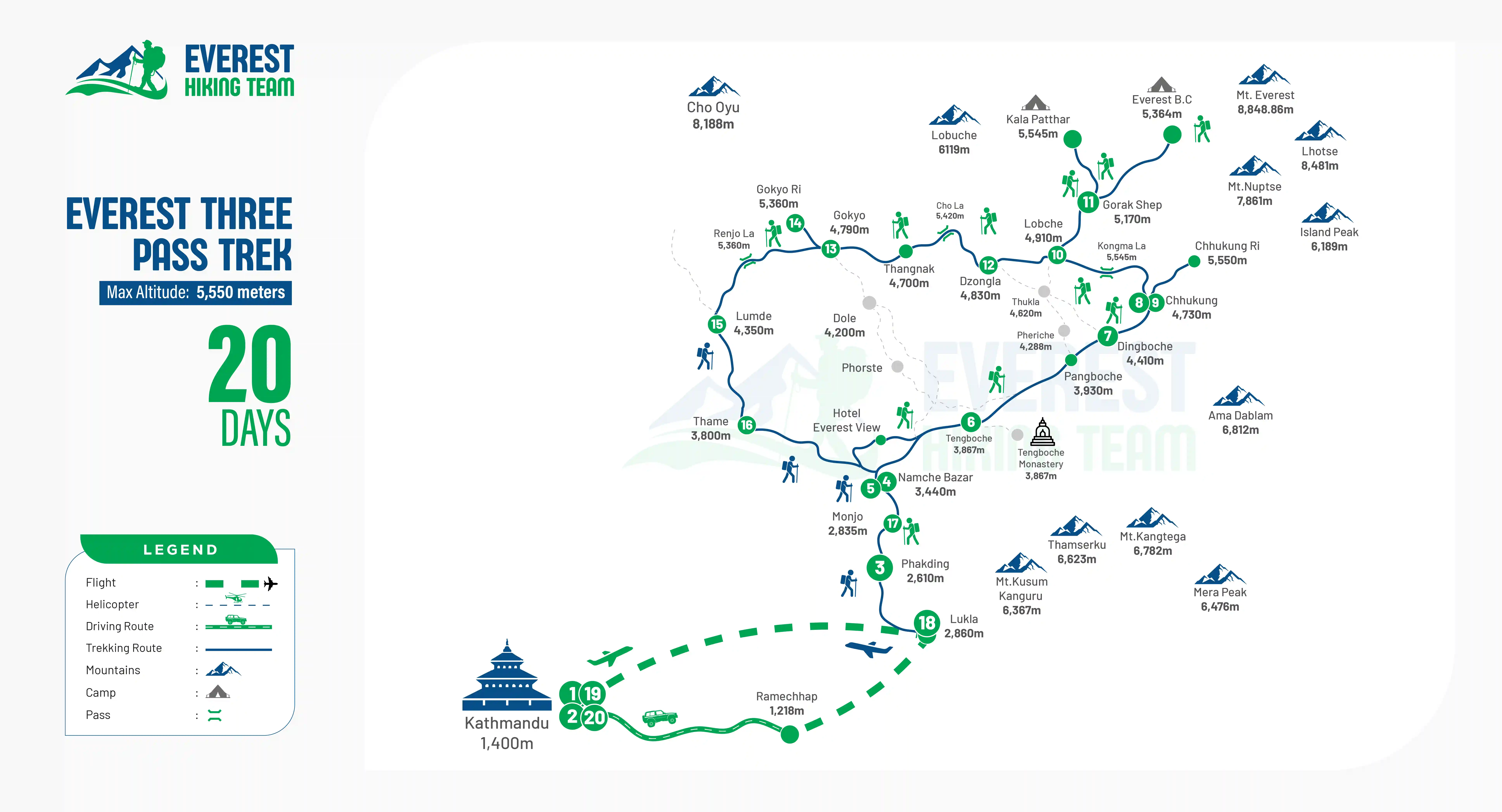
Trek Route

Everest three pass trek 20 days

Packing List

Clothing (Layering Systems)

  • Insulated down jacket, high-quality and cold-rated
  • Shell jacket with Gore-Tex-like waterproof and windproof properties
  • Fleece Jacket or Warm Mid-layer
  • Two layers of thermal base layer (top and bottom).
  • 2 trekking pants (quick-dry)
  • Warm insulated pants for high altitude
  • Lightweight t-shirts (moisture-wicking)
  • Warm hat/beanie
  • Sun Hat or Cap
  • Neck gaiter/buff (very important in wind and dust).
  • Lightweight gloves
  • Heavy insulated gloves for outer passes
  • Poncho or waterproof rain cover

Footwear

  • Boots for hiking with waterproof protection (well-worn in).
  • Sandals or camp shoes (for evenings).
  • 4-6 pairs trekking socks (wool recommended)
  • 2 or 3 liner socks for extra comfort
  • Gaiters are useful for snow and scree in the passes.

Trekking Gear

  • 50-70L backpack (for main luggage if no porter)
  • Daypack 25-35L (for essentials daily)
  • Sleeping bag (-15degC or -20degC recommended)
  • Trekking poles are essential for climbing.
  • Headlamp with Extra Batteries
  • Hydration bladders or water bottles (2 x 1L).
  • Dry bags and pack liners that are waterproof

Personal Items

  • Sunscreen (SPF50+ high altitude protection).
  • Lip Balm with SPF
  • Baby wipes/wet wipes
  • Quick-dry towel
  • Toothbrush, toothpaste, biodegradable soap
  • Hand sanitizer
  • Toilet paper is very important for trek sections.
  • Small First-Aid Kit (basic Personal Medication)

Health & Safety

  • Altitude sickness medication. Consult your doctor if necessary.
  • As prescribed, painkillers and antibiotics are available.
  • Electrolytes / Rehydration Salts
  • Bandages and blister plasters
  • Prescription medicines for personal use

Electronics

  • Phone + charging cable
  • Power Bank (10,000-20000 mAh)
  • Universal travel adapter
  • Camera (optional, but recommended)
  • Additional batteries (cold decreases battery life).

Optional but Useful

  • Snacks: energy bars, chocolates and nuts
  • Thermos flasks are lightweight.
  • Binoculars for mountain viewing
  • Evenings: Book or Kindle
  • Duffel bag lock small.
  • Important Documents
  • Passport valid for at least 6 months
  • Nepal Visa (on arrival or in advance)
  • Travel insurance must cover high altitude treks up to 6,000m
  • Passport-size photographs (for permits, if necessary)
  • Flight tickets and confirmations of bookings

Essentials for Cold Weather

  • A combination of a down jacket and a sleeping bag (critical for passes).
  • Gloves, both heavy and light
  • Buff/neck gaiter
  • Thermal base layers
  • Windproof outer shell


What's included

  • Domestic flight tickets from Kathmandu to Lukla and back
  • Three meals a day during the trek (breakfast, lunch, and dinner)
  • Accommodation in local teahouses throughout the trek
  • Kit bag to carry and store your personal belongings
  • Sleeping bag suitable for cold temperatures during the trek
  • Sagarmatha National Park entry permit
  • Khumbu Pasang Lhamu Rural Municipality permit
  • Experienced government-licensed English-speaking trekking guide
  • Porter service (one porter shared between two to three trekkers) and solo trekkers may require an additional porter fee
  • Food, accommodation, salary, and insurance for guides and porters
  • All required permits, paperwork, government taxes, and service charges
  • Trek completion certificate after successfully finishing the trek

What's excluded

  • International flight tickets to and from Nepal
  • Nepal entry visa fee
  • Hotel accommodation and meals in Kathmandu before and after the trek
  • Personal trekking gear and clothing
  • Travel insurance, including emergency helicopter rescue and evacuation
  • Soft drinks, alcoholic drinks, tea, coffee, and other beverages

Frequently Asked Questions

How difficult is the Everest Three Pass Trek?

Everest Three Pass Trek can be a difficult high-altitude hike due to the long walking days, three major passes over 5,300m (Kongma La, Cho La and Renjo La), and other factors. The Everest Three Pass Trek requires good fitness, stamina and previous trekking experience. But with the right-paced itinerary and proper acclimatization, physically fit trekkers can accomplish the trip

Until what height do I reach in this trekking adventure?

Kala Patra (5,545m / 18,192 ft.), followed by Kongma La Pass (5,545m) and ChhukungRi, provide some of the most spectacular scenery of the Everest from these altitudes in the Everest region.

What kind of accommodations will I have during my trekking?

You will stay in a mountain teahouse lodging with bathroom facility sharing with other trekkers when trekking in the Everest region. Before and after trekking, you will stay in a 3-star hotel in Kathmandu

Is trekking experience necessary for the Everest Three Pass trekking?

No, previous trekking experience is not necessary, but it is highly advised to ensure that your treks become easy owing to the high altitude and extended hours of trekking. Yet, trekking can become easy if one prepares well and trains themselves properly prior to the expedition.

What sort of food shall I be offered during my treks on the Everest Three Pass Treks?

Provision for breakfast, lunch, and dinner is available for all treks. The food offered during treks includes healthy local dishes like dal-bhat, noodles, and soups.

What kind of gear should I carry during my trekking on the Everest Three Pass Trek?

Carry layer clothing to prepare for fluctuating temperatures. Carry a down jacket and a waterproof jacket. Also carry trekking pants, gloves and a hat. Carry a sleeping bag at temperatures ranging from -15 degree celsius to -20 degree celsius and trekking poles, a head lamp, personal medications and a head lamp. It is important to wear suitable footwear when you reach high passes to avoid cold conditions.

User Review