Langtang Valley Trek for 11 Days

Tour Info

Trip code

E-008

Starting Point/ End Point

kathmandu

Accommodations

Lodge/Tea House

Max Altitude

5,000 meters (Tserko Ri)

Duration

11 days

country

Trip grade

Moderate

Best Season

Spring (March–May) and Autumn (September–November)

Highlights

  • Enjoy beautiful sunrise views from several scenic viewpoints along the Langtang trekking route
  • Witness spectacular mountain panoramas featuring Langtang Lirung (7,227m), Langtang II (6,596m), Ganesh Himal (7,422m), and many other Himalayan peaks
  • Hike to popular viewpoints such as Kyanjin Ri (4,773m) and Tserko Ri (5,000m) for outstanding views of glaciers and surrounding mountains
  • Walk through the diverse landscapes of Langtang National Park, home to a variety of plants, forests, and alpine vegetation
  • Trek along peaceful trails passing through rhododendron, bamboo, oak, and pine forests
  • Experience the rich culture, traditions, and daily lifestyle of the local Tamang communities living in the Langtang Valley
  • Explore traditional mountain villages, ancient monasteries, and important Buddhist heritage sites
  • You can also counter wildlife such as red pandas, Himalayan tahr, langur monkeys, musk deer, Himalayan black bears, and various bird species
  • Visit the famous Kyanjin Gompa and learn about the area's religious and cultural significance
  • Enjoy the warm hospitality of local teahouse owners while tasting traditional Nepali and Tibetan-inspired dishes throughout the trek

Overview

The Langtang Valley Trek is a well-known Himalayan trek located in Langtang National Park, just north of Kathmandu near the Tibetan border. It is a moderate-level trek that usually takes around 11 days depending on the route and side trips. The journey starts from Syabrubesi and passes through rivers, forests, and traditional Tamang villages before reaching Kyanjin Gompa at 3,830 meters. Along the way, trekkers enjoy stunning views of Langtang Lirung (7,246m), Dorje Lakpa (6,966m), Gang Chhenpo (6,388m), and Naya Kanga (5,846m). The trail offers a mix of natural beauty and cultural experience, with rhododendron and oak forests, suspension bridges, and chances to see wildlife like red pandas and langur monkeys. The region reflects strong Tamang and Tibetan Buddhist culture with prayer flags, monasteries, and warm hospitality in villages like Lama Hotel and Kyanjin Gompa. Being close to Kathmandu, it is more affordable and less crowded than Everest and Annapurna regions while still offering rich mountain scenery and cultural depth.

Itinerary

Day 1: Arrival Kathmandu Hotel Transfer by Private Car

Upon arrival at Tribhuvan International Airport, our representative will warmly welcome you and transfer you to your hotel by private vehicle. After check-in, you can take some rest and recover from your journey. In the evening, a short briefing session will be held at our office where you will meet your trekking guide and team, and get important information about the trek. You can also ask any questions regarding the trip. Later, you may stroll around the lively streets of Thamel and explore the area

  • Max Elevation: 1,350 meters (Kathmandu)
  • Travel Distance: 6 to 8 kilometers
  • Travel Hours: 20 to 30 minutes
  • Accommodation: 3 Star Hotel
  • Meal: Welcome Dinner
Day 2: Sightseeing in Kathmandu and Trek Briefing

After breakfast at the hotel, your sightseeing tour starts around 8 AM. You will travel in a private vehicle for the whole day, making it easy and comfortable. A professional guide will be with you to explain the history and importance of each place. The day is planned in a slow and relaxed way so you can enjoy every site properly. You will visit some of the most important cultural and religious sites in Kathmandu Valley.

A. Pashupatinath
Pashupatinath is a famous Hindu temple dedicated to Lord Shiva, located beside the Bagmati River. Non-Hindus cannot enter the main temple, but you can see the temple area and daily rituals from outside.

B. Boudhanath
Boudhanath is a large Buddhist stupa and a very peaceful place. People walk around the stupa and spin prayer wheels as part of their religious practice.

C. Patan Durbar Square
Patan Durbar Square is known for its old palaces, temples, and beautiful Newari architecture. It shows the rich history and art of the Kathmandu Valley.

D. Swayambhunath Stupa (Monkey Temple)
Swayambhunath is a stupa located on a hill with a nice view of the city. It is also called Monkey Temple because many monkeys live there. It is an important place for both Hindus and Buddhists.

  • Max Elevation: 1,450 meters (Swayambhunath Stupa)
  • Travel Distance: 25 to 30 kilometers (total driving distance)
  • Travel Hours: 6 to 7 hours
  • Accommodation: 3 Star Hotel
  • Meal: Breakfast, Lunch, and Dinner
Day 3: Drive to Syabrubesi (1,467 meters) 6 hours

After breakfast, our team picks you up from the hotel and begins a scenic drive toward Syabrubesi, a small but busy town and the starting point of  the gateway to the Langtang region. The journey takes you through winding roads, green hills, rivers, waterfalls, and traditional villages. Along the way, you can enjoy distant views of mountains like Ganesh Himal, Manaslu, and Langtang ranges on clear days. By afternoon, you reach Syabrubesi after around 6 hours of driving. After reaching, you can rest and prepare for the trek ahead, staying in a comfortable teahouse with meals included.

  • Max Elevation: 1,467 meters
  • Travel Distance: 122 kilometers
  • Travel Hours: 6 hours
  • Accommodation: Teahouse/Lodge
  • Meal: Breakfast, Lunch, and Dinner
Day 4: Trek to Lama Hotel (2,470 meters)

You start your trek with a river crossing over the Bhote Koshi and continue along the Langtang Khola inside Langtang National Park, after having breakfast in Syabrubesi. The trail enters dense forests filled with bamboo, oak, and rhododendron trees. While walking, you may see wildlife such as red pandas, langur monkeys, Himalayan black bears, musk deer, wild honey (Bee Hive) and different bird species including the Himalayan Monal. Then , the path gradually moves through small settlements like Bamboo and Rimche, where you can take short breaks. Route also includes suspension bridges and beautiful river views. By late afternoon, you reach Lama Hotel, a quiet teahouse area surrounded by forest, perfect for rest before continuing the journey deeper into the valley.

  • Max Elevation: 2,470 meters
  • Travel Distance: 11 to 12 kilometers
  • Travel Hours: 6 to 7 hours
  • Accommodation: Teahouse/Lodge
  • Meal: Breakfast, Lunch, and Dinner
Day 5: Trek to Langtang Village (3,430 meters)

After breakfast at Lama Hotel, the trail starts with a gentle climb that gradually becomes steeper as you move deeper into the forest. The route passes through oak, maple, rhododendron, and other alpine trees, with occasional glimpses of Mt. Langtang Lirung along the way.  As you continue through the Langtang village, you may even witness wildlife such as Himalayan langur monkeys, musk deer, Himalayan black bears, elusive red pandas, and a variety of colorful bird species, including the Himalayan Monal (Nepalese national bird). 

You will also cross several small log bridges over streams while following the Langtang Khola. After a few hours, you reach Ghodatabela (2,992m), a beautiful open meadow where you can take a short rest. From here, the trail continues through a mix of forest, open land, and small helipad areas. You also pass streams, prayer wheels, and traditional water mills before entering the wide Langtang Valley.  While approaching this valley, you can notice a memorial which is dedicated towards the victims of the devastating earthquake which occurred in Nepal in 2015. This earthquake triggered a massive avalanche which buried the original village, claiming the lives of more than 300 people including local residents and foreign trekkers. 

Finally, you arrive at Langtang Village (3,430m), a large Tamang settlement surrounded by stone-walled fields used to protect crops from strong winds. 

  • Max Elevation: 3,430 meters
  • Travel Distance: 14 to 15 kilometers
  • Travel Hours: 6 hours
  • Accommodation: Teahouse/Lodge
  • Meal: Breakfast, Lunch, and Dinner
Day 6: Trek to Kyanjin Gumba (3,870 meters) 3 hours walk then explore Kyanjin Gumba

After breakfast in Langtang Village, you begin a short and pleasant uphill walk toward Kyanjin Gumba. The trail is gradual and peaceful, passing mani walls (prayer walls) where you should walk clockwise as a sign of respect for Buddhist culture. As you continue, the valley slowly opens up and you start seeing wider views of snow-covered peaks. The walk is easy and scenic, taking around 3 hours in total. Along the way, you enjoy beautiful mountain scenery and peaceful surroundings before reaching Kyanjin Gumba, a stunning village surrounded by glaciers, rocky moraines, and high peaks like Langtang Lirung (7,234 meters). You can explore the area, visit the old traditional monastery, and enjoy the incredible Himalayan views, once you arrive at Kyanjin Gumba. In addition, you can also visit the old yak cheese factory, known as Kyanjin Gompa Cheese Factory. This is your stop for today and a perfect place to rest and experience high mountain life.

  • Max Elevation: 3,870 meters
  • Travel Distance: 7 to 8 kilometers
  • Travel Hours: 3 hours walk
  • Accommodation: Teahouse/Lodge
  • Meal: Breakfast, Lunch, and Dinner
Day 7: Acclimatization / Viewpoint (Kyanjin Ri 4,773 meters Or Tserko Ri 5,000 meters)

This is an important acclimatization day to help your body adjust to the high altitude. After an early breakfast, you start your hike toward either Kyanjin Ri or Tserko Ri, depending on your energy and fitness level. The trail is steep and challenging, but the views become more rewarding as you climb higher. It takes you around 4 to 6 hours for the round trip and 6 to 8 hours for Tserko Ri, with rocky paths and thin air making it a bit tough. From the top, you get stunning panoramic views of Langtang Lirung, Yala Peak, Naya Kanga, Dorje Lhakpa, glaciers, and surrounding Himalayan ranges. After spending some time at the viewpoint, you can descend back to Kyanjin Gompa for rest.

  • Max Elevation: 5,000 meters (Tserko Ri)
  • Travel Distance: 7 to 10 kilometers (round trip)
  • Travel Hours: 4 to 6 hours
  • Accommodation: Teahouse/Lodge
  • Meal: Breakfast, Lunch, and Dinner
Day 8: Trek Down to Lama Hotel (2,470 meters)

Following your stay at Kyanjin Gompa, the journey now continues back toward Lama Hotel by retracing the same scenic route. The total distance is around 21.6 km, and the walk usually takes about 6 to 7 hours. The trail mostly goes downhill, making the descent faster and easier compared to the climb. Along the way, you enjoy beautiful views of snowy peaks one last time while walking beside the Langtang River. The route passes through Langtang Village and Ghodatabela before reaching the forested area of Lama Hotel. You descend over 1,400 meters on this day, moving through rhododendron and oak forests filled with natural beauty. You will spend the night in Lama Hotel, staying at a quiet and comfortable teahouse surrounded by forest, where you can relax and recover after a long day of trekking.

  • Max Elevation: 3,870 meters
  • Travel Distance: 20 to 21 kilometers
  • Travel Hours: 6 to 7 hours
  • Accommodation: Teahouse/Lodge
  • Meal: Breakfast, Lunch, and Dinner
Day 9: Trek Down to Syabrubesi (1,467 meters)

The journey continues downhill as you make your way back to Syabrubesi, marking the nearing end of your Langtang Valley Trek. The trail is mostly descending and passes through beautiful green forests, rivers, and small traditional villages along the way. This section offers a chance to enjoy the peaceful surroundings and observe local lifestyle and culture once again. As you walk, you follow familiar paths through rhododendron and bamboo forests while enjoying views of rolling hills and distant mountains. The trek gradually becomes easier as you lose altitude. After around 5 to 6 hours of walking, you arrive at Syabrubesi. In the evening, you can relax and enjoy your final night, with an option to visit the nearby natural hot spring for rest and recovery.

  • Max Elevation: 2,470 meters
  • Travel Distance: 11 to 12 kilometers
  • Travel Hours: 5 to 6 hours
  • Accommodation: Teahouse/Lodge
  • Meal: Breakfast, Lunch, and Dinner
Day 10: Drive Back to Kathmandu

The journey back to Kathmandu begins from Syabrubesi after completing the Langtang Valley Trek. Route is scenic and takes around 6 hours, passing through winding mountain roads, the Trishuli River valley, terraced farmlands, and small rural settlements. Along the way, you can enjoy the final views of Nepal’s green hills and countryside landscapes. After reaching Kathmandu, you will be transferred to your hotel. Then, the rest of the day is free for relaxation, shopping, or enjoying a soothing massage after the trek. In the evening, a farewell dinner will be organized at a traditional Nepali restaurant, where you can enjoy local food and cultural performances to celebrate the successful completion of your journey.

  • Max Elevation: 1,467 meters
  • Travel Distance: 122 kilometers
  • Travel Hours: 6 to 7 hours
  • Accommodation: 3 Star Hotel
  • Meal: Breakfast, Lunch, and Farewell Dinner
Day 11: Final Departure

Your Langtang Valley adventure comes to an end today. Depending on your flight schedule, our team will transfer you to Tribhuvan International Airport for your onward journey. If you have some free time before your flight, you can enjoy a relaxed morning in Kathmandu and reflect on the wonderful memories made during the trek. As you leave Nepal, you take home unforgettable experiences of beautiful mountain landscapes, traditional villages, rich culture, and the warm hospitality of the local people. We hope to welcome you again for another Himalayan adventure in the future.

  • Max Elevation: 1,350 meters (Kathmandu)
  • Travel Distance: 6 to 8 kilometers
  • Travel Hours: 20 to 30 minutes
  • Meal: Breakfast

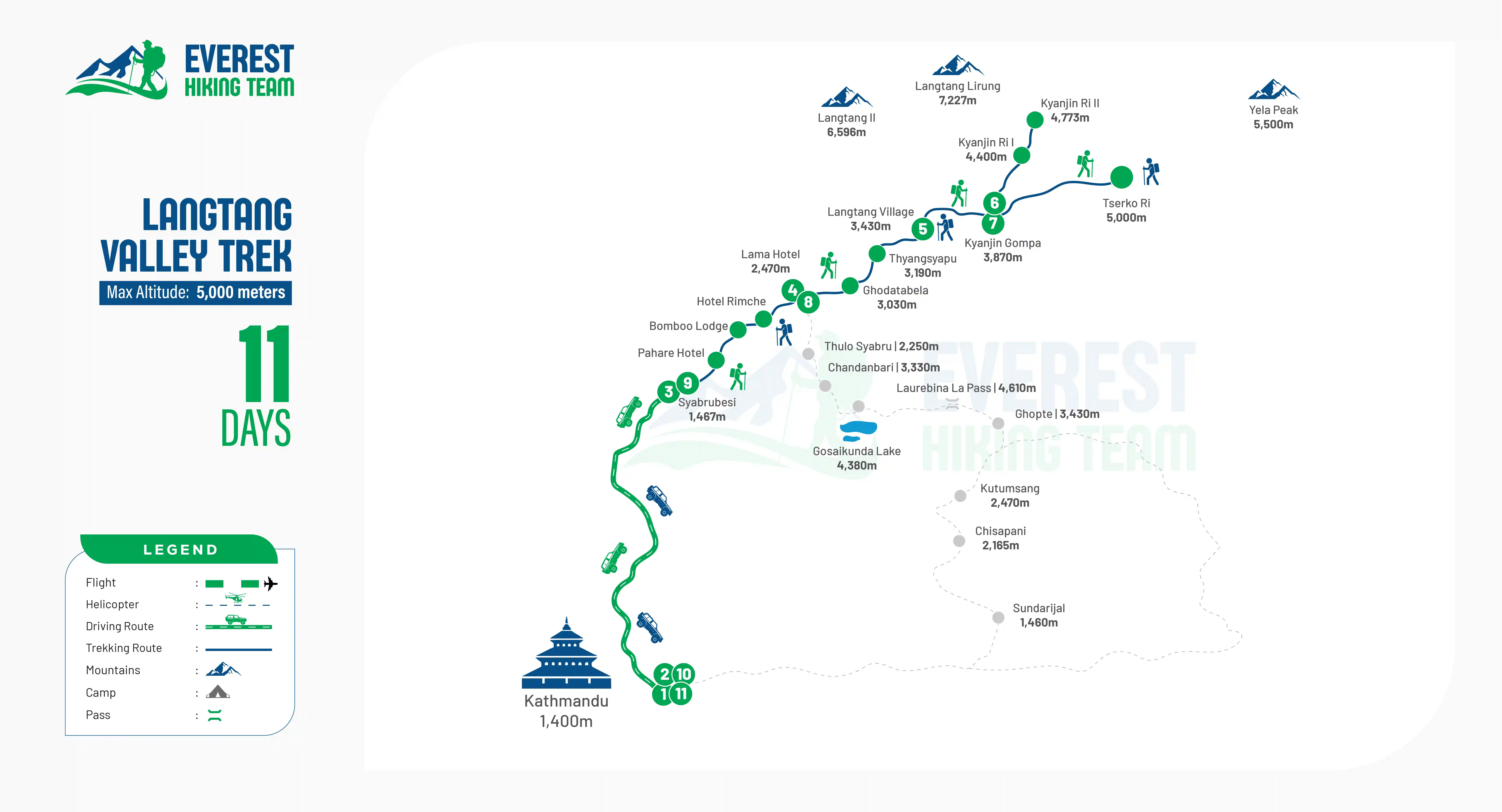
Trek Route

Lantang valley trek 11 days

Packing List

Packing the right gear is important for a comfortable and successful Langtang Valley Trek. The trail reaches elevations of up to 5,000 meters, where temperatures can vary significantly between day and night. Weather in the Himalayas can change quickly, so carrying proper clothing and equipment will help you stay warm, dry, and prepared throughout the journey.

General Equipment

  • Four-season sleeping bag (rated around 0°C to -15°C)
  • Warm down jacket
  • Day backpack (35 to 45 liters) with rain cover
  • Sleeping bag liner
  • Duffel bag for porter use
  • Waterproof stuff sacks or dry bags

Upper Body Clothing

  • Sun hat or trekking cap
  • Warm woolen hat or beanie
  • Headlamp with extra batteries
  • UV-protection sunglasses
  • Lightweight thermal top
  • Heavy thermal top for colder seasons
  • Two short-sleeve trekking shirts
  • Two long-sleeve trekking shirts
  • Waterproof and windproof outer jacket
  • Fleece jacket or insulated mid-layer

Lower Body Clothing

  • Thermal leggings or base layer bottoms
  • Two pairs of trekking trousers
  • Lightweight hiking shorts
  • Comfortable trousers for evenings
  • Waterproof over-trousers for rain and wind protection
  • Hand Protection
  • Lightweight inner gloves
  • Warm insulated waterproof gloves

Footwear

  • Waterproof trekking boots with good ankle support
  • Warm wool socks
  • Regular hiking socks
  • Thin liner socks (optional)
  • Camp shoes or sandals
  • Gaiters for dust, mud, or snow conditions
  • Microspikes for icy trails during colder months

Undergarments

  • Quick-drying underwear
  • Sports bras for female trekkers
  • Comfortable sleepwear

First Aid and Health Supplies

  • Personal prescription medicines
  • High-SPF sunscreen
  • Lip balm with sun protection
  • Antiseptic cream
  • Bandages and blister care supplies
  • Pain relief tablets
  • Oral rehydration packets
  • Diamox or altitude medication (after medical advice)

Important Essentials

  • Passport and permit copies
  • Passport-size photographs
  • Travel insurance documents
  • Reusable water bottles
  • Hydration bladder
  • Water purification tablets or purifier
  • Toiletries and personal hygiene items
  • Quick-dry towel
  • Toilet paper
  • Hand sanitizer
  • Wet wipes
  • Energy snacks, nuts, chocolate, or protein bars
  • Waterproof pouch for valuables
  • Earplugs
  • Trekking poles

Optional Items

  • Power bank
  • Spare batteries
  • Camera and memory cards
  • Mobile phone
  • Universal travel adapter
  • Book or journal
  • Playing cards
  • Binoculars
  • Emergency whistle
  • Thermos flask
  • Comb or brush
  • Small repair or sewing kit

What's included

  • Airport pick-up and drop-off by private vehicle
  • Three nights' accommodation in a 3-star hotel in Kathmandu on a twin-sharing basis with breakfast included
  • Three meals a day during the trek (breakfast, lunch, and dinner) with one cup of tea or coffee at each meal
  • Teahouse/lodge accommodation throughout the trekking period
  • Langtang National Park Entry Permit
  • TIMS (Trekkers' Information Management System) Card
  • Round-trip transportation between Kathmandu and Syabrubesi by local bus
  • Experienced English-speaking licensed trekking guide, including salary, meals, accommodation, transportation, and insurance
  • Strong and reliable porter service (1 porter for every 2 trekkers), including salary, meals, accommodation, and insurance
  • Basic first aid kit carried by the guide
  • Assistance with emergency helicopter rescue arrangements if required (rescue costs covered by your travel insurance)
  • Company duffel bag, trekking T-shirt, and cap
  • Government taxes, service charges, and official fees
  • Guided sightseeing tour in Kathmandu with private transportation
  • Daily oxygen saturation and pulse monitoring using an oximeter to help monitor altitude sickness symptoms
  • Safe luggage storage facility in Kathmandu for items not needed during the trek
  • Assistant guide for groups of more than 6 trekkers

What's excluded

  • Lunch and dinner while staying in Kathmandu
  • Nepal entry visa fee (available on arrival at the airport)
  • Personal travel and medical insurance
  • International flight tickets
  • Personal expenses such as shopping, laundry, and extra services
  • Rental cost or maintenance charges for sleeping bags, down jackets, and trekking poles if provided by the company
  • All alcoholic beverages, soft drinks, bottled drinks, and additional hot beverages
  • Snacks, chocolates, cakes, desserts, and other personal food items
  • Tips for guides, porters, and drivers
  • Entrance fees for monuments and heritage sites during the Kathmandu sightseeing tour
  • Private jeep transportation between Kathmandu and Syabrubesi (available at an additional cost upon request)

Frequently Asked Questions

How difficult is the Langtang Valley Trek?

The Langtang Valley Trek is considered a moderate trek and is suitable for beginners with a reasonable fitness level. Most trekking days involve 5 to 7 hours of walking on forest trails, stone steps, and mountain paths. No technical climbing skills are required, but good stamina helps, especially on the uphill sections between Lama Hotel and Langtang Village.

Is altitude sickness a concern during the Langtang Trek?

Yes, altitude sickness can affect some trekkers once they reach elevations above 3,000 meters. Common symptoms include headache, dizziness, nausea, and fatigue. Proper acclimatization, drinking plenty of water, walking at a steady pace, and following the itinerary carefully help reduce the risk of altitude-related problems.

What is the best time to do the Langtang Valley Trek?

Spring (March to May) and autumn (September to November) are the best seasons. During these months, the weather is generally stable, mountain views are clear, and the trails are in good condition. Spring offers blooming rhododendron forests, while autumn provides excellent visibility after the monsoon season.

What permits are required for the Langtang Trek?

Trekkers need two permits for the Langtang Valley Trek: the Langtang National Park Entry Permit and the TIMS (Trekkers' Information Management System) Card, depending on current regulations. These permits help support conservation efforts and ensure trekker safety throughout the region.

Can beginners complete the Langtang Valley Trek?

Yes, many first-time trekkers successfully complete the Langtang Trek every year. The route does not require previous trekking experience or technical skills. However, some preparation such as regular walking, hiking, or cardio exercises before the trip can make the journey much more enjoyable.

What are the major highlights of the Langtang Valley Trek?

The trek offers beautiful forests, traditional Tamang villages, Buddhist monasteries, glaciers, and stunning mountain views. Highlights include Langtang Village, Kyanjin Gompa, Kyanjin Ri (4,773m), Tserko Ri (5,000m), and spectacular views of Langtang Lirung and surrounding Himalayan peaks. It is also less crowded than many other popular trekking routes in Nepal.

User Review